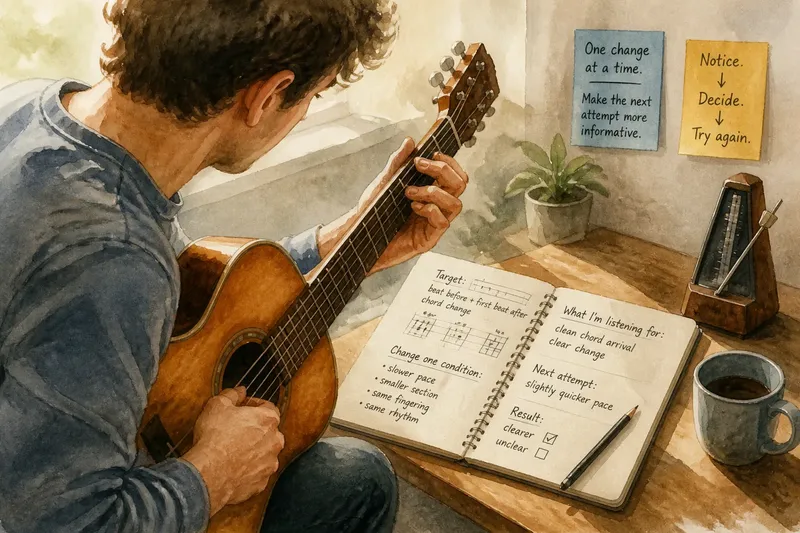
The Warm-Up Task That Gets Your Attention into the Room
A warm-up task for focused practice helps you settle in, notice what needs attention and begin without letting the starter consume your session.
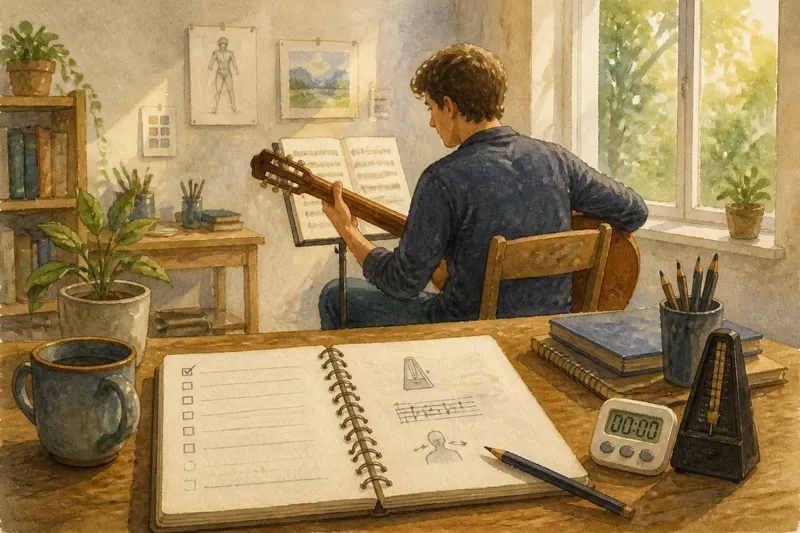
You sit down with your guitar, open the sheet music and suddenly remember the mug in the kitchen. A familiar warm-up task can help bring your attention into the room before focused practice begins. The trick is choosing a small task that points towards the work, rather than becoming the work.
1. Choose a task that belongs to the skill
A useful starter has a clear connection to the practice you intend to do. If you are learning a language, you might review a handful of words you already know. For drawing, you could sketch a simple object using shapes you have practised before. The task should feel recognisable enough that you can begin without a long decision-making pause.
That connection gives your mind a gentle landing. You move from whatever was happening before into an action that uses the same tools, materials or attention as the main session. A starter that is unrelated may be pleasant, but it is less likely to prepare you for the next task.
Say you plan to practise a difficult piano passage. You begin by playing a familiar scale at an easy pace, listening for an even sound. When you move to the passage, your hands and ears are already engaged, and you have a natural point of comparison for the sound you want.
2. Make the first action obvious
At the start of a session, even a small choice can become a reason to put things off. Decide in advance what the starter involves: which page to open, which exercise to play or which materials to place on the desk. “Work on Spanish” is too broad; “read yesterday’s short dialogue aloud” gives you a place to begin.
Keep the task familiar, but not entirely automatic. If it demands all your concentration, it may be the main practice in disguise. If it needs none, it can leave your attention drifting. Aim for an action that lets you participate without wrestling with a new problem straight away.
For example, a singer might start by reading a familiar line of music and quietly noticing where the breaths fall. There is little to set up, yet the action directs attention towards phrasing and breath, both relevant to the session ahead.
3. Give the starter a natural stopping point
A warm-up task needs an exit as well as an entrance. Choose a small boundary that tells you the starter has done its job: one familiar exercise, a short passage, or one pass through a known sequence. The boundary can be based on completion rather than a clock.
This matters because easy tasks are inviting. A musician can keep replaying a comfortable scale; a language learner can revisit familiar vocabulary instead of attempting to speak. A clear stopping point makes it easier to carry the attention you have gathered into the less comfortable part of practice.
Notice the difference between “I’ll keep going until I feel ready” and “I’ll play this familiar phrase once, then begin the new passage”. The first leaves the transition open-ended. The second makes the next action visible before you start.
4. Let the starter reveal one useful detail
The warm-up can also give you a quick reading of your present attention. You might notice that your hands feel tense, that you are rushing, or that your mind keeps returning to an unfinished errand. The point is not to diagnose yourself or fix everything before practice. It is to notice one detail that can shape the session.
Imagine you are about to work on a tricky section of a dance routine. During a familiar sequence, you notice that you are moving faster than the music. You can begin the new section with a simple intention: listen for the beat before adding speed. The starter has helped you arrive and given the main practice a useful focus.
Keep the observation modest. A starter is not a test of whether you are ready, talented or disciplined. Some days attention will settle quickly; on others, you may still feel distracted. You can begin the planned work without waiting for a perfect state of mind.
5. Adjust the task to the kind of session
The same warm-up need not suit every practice session. If you are working on accuracy, a familiar, controlled exercise may help you attend to small details. If the session is about speaking fluently, reading a known paragraph aloud may be a better lead-in than silently reviewing notes.
Match the starter to the quality of attention the next task needs, not to its difficulty alone. A demanding session may call for something calm and predictable. A session that feels flat may benefit from an engaging but still familiar action, such as sketching a favourite object before tackling a new composition exercise.
There is no need to build an elaborate routine with several stages, special equipment or a carefully arranged soundtrack. If setting up the starter takes longer than beginning the practice, simplify it. A book already open on the desk, a pencil beside the paper or an instrument within reach can be enough.
What makes a warm-up task useful?
How long should a practice warm-up take?
Keep it short enough that the main practice still feels like the centre of the session. A clear stopping point, such as one familiar passage, is often easier to follow than waiting until you feel completely ready.
Should the warm-up be easy?
It should be familiar enough to start without a struggle, while still asking for some attention. If you need to solve a difficult new problem, it may belong in the main practice instead.
Can I use the same warm-up every time?
Yes, if it connects to the skill and continues to serve the session. You can also keep a small choice of starters for different kinds of work, such as a listening task for music and a spoken review for language practice.
What if I still feel distracted afterwards?
Move into the planned practice and make the first stretch manageable, rather than repeating the warm-up until you feel flawless. Attention can gather while you work; the starter is a transition, not a pass-or-fail test.
Keep the handover simple
Once the starter ends, make the next action specific. Turn to the marked page, select the passage or set out the materials for the task you meant to practise. Avoid adding another preparatory activity simply because it feels comfortable.
A good warm-up task for focused practice is less like a ceremony than a small doorway: familiar enough to cross easily, connected enough to lead somewhere. Choose one that helps you notice what is happening, stop before it takes over, and let the real practice begin with your attention already in the room.