A Short History of Rehearsal, from Ancient Drama to Modern Performance
The history of rehearsal, from ancient Greek drama to modern performance, explains how performers use shared practice to coordinate, interpret and adapt.
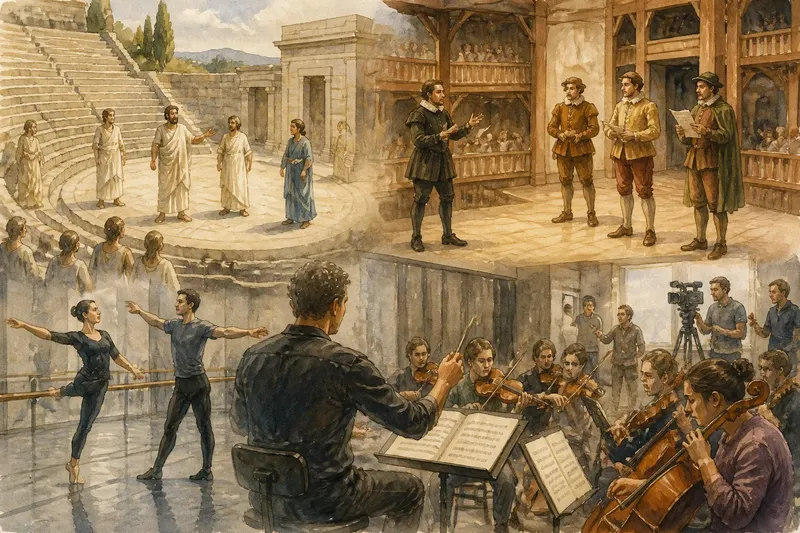
Before a theatre audience arrives, actors may walk through entrances, musicians check cues and a director pauses to adjust a scene. The history of rehearsal reaches back to ancient Greek drama, but its purpose has never been limited to running a performance from beginning to end.
What can we say about rehearsal in ancient Greece?
Ancient Greek drama offers an early, well-known setting for organised performance, including plays staged at festivals. These productions involved actors and a chorus, so coordinating speech, movement and music mattered. The surviving evidence does not give us a complete account of how performers prepared, and it is safer to describe the demands of performance than to claim a single origin for rehearsal.
The practical challenge is easy to recognise: performers sharing a stage need to know when to speak, move or respond. Preparation for a festival performance could involve learning a sequence and coordinating a group, though the precise methods likely varied across productions and periods.
How did theatre rehearsal develop in early modern Europe?
In early modern England, professional theatre companies performed plays in commercial venues such as London’s public theatres. Playwrights including William Shakespeare wrote for these companies, where actors had to bring scripts, roles and stage action together. Surviving play texts and theatrical records offer clues about performance, but they do not provide a full day-by-day record of rehearsal routines.
In this setting, learning a role and preparing entrances were practical concerns for a company. The work should not be imagined as identical to a present-day rehearsal with a director guiding a long, continuous process: theatrical conditions, resources and conventions differed. The useful historical point is that performance depended on collective preparation, even when the details of that preparation are only partly documented.
When did rehearsal become a space for interpretation?
Across later European theatre and music traditions, professional roles such as director and conductor became more prominent. Their work helped make rehearsal a place not only to coordinate performers but also to shape a particular interpretation: the pace of a scene, the balance between instruments or the meaning of a pause.
That development was not a single turning point. Different companies and musical institutions adopted different working methods. Still, the distinction is useful: a group can first establish that everyone knows the sequence, then use repeated passages to compare artistic choices.
Say a small ensemble preparing a piece finds that its quiet ending feels abrupt. The players agree to hold a little more space before the final note and listen to the result in the next run. If the ending now feels more settled to them, they have a clear interpretation to keep or revise; if it still feels abrupt, they can try another choice rather than repeating the same version automatically.
How did modern rehearsal broaden beyond the stage?
In more recent performance practice, rehearsal has encompassed theatre, orchestral music, dance, opera, film and broadcast production. Each form brings different demands. A stage actor may need to coordinate movement with a partner; an orchestra aligns tempo and balance; a film cast may repeat a scene for camera and continuity needs.
Modern rehearsal is not one universal method. Some productions rely on extensive development in the room, while others have tight schedules or established conventions. The common thread is that rehearsal gives people a chance to coordinate a shared performance and make decisions before an audience or recording captures it.
What should a rehearsal focus on today?
Start with the uncertainty that could most disrupt the shared work. Check each point below and choose the action that follows:
- Entrances: Check whether each performer can identify the cue. If someone hesitates, repeat the moment with the preceding cue; otherwise, move on to the next uncertainty.
- Transitions: Check whether the group knows how one section hands into the next. If the hand-off is unclear, practise those adjoining sections; if it is secure, do not keep repeating it without a reason.
- Timing: Check whether performers agree on tempo or pace. If they differ, choose a shared reference such as a conductor’s beat or a spoken count; if they already align, focus elsewhere.
- Interpretation: Check whether a specific pause, emphasis or movement communicates the intended effect to the performers. If it does not, compare a small alternative; if it does, keep the choice and continue.
- Venue conditions: Check sightlines, acoustics and movement in the actual space when possible. If a cue is hard to see or hear, adapt its placement or delivery; if it is clear, retain the existing arrangement.
- Readiness after a break: Check whether the group remembers the sequence and shared timing. If either feels uncertain, re-establish the sequence before polishing details; if both are familiar, resume at the current artistic question.
What do people ask about the history of rehearsal?
Did rehearsal begin in ancient Greece?
Ancient Greek drama is an early, documented context for organised group performance, but evidence does not establish a single birthplace for rehearsal. People in many cultures have prepared performances, and the surviving records are uneven.
How is rehearsal different from practice?
Practice can focus on one person’s skill, such as a musician working on a passage alone. Rehearsal usually prepares a shared performance, adding coordination, cues and decisions between participants.
Why do performers repeat only one section?
A focused repeat lets a group attend to a particular entrance, transition or interpretive choice. A full run can reveal how the whole performance holds together, but it may not give a local problem enough attention.
Does rehearsal always aim for perfection?
No. It can help performers learn a sequence, adapt to a venue or settle how they will work together. The immediate goal depends on what remains uncertain.
What is not worth rehearsing endlessly?
Repeating a passage without a question in mind can consume attention without clarifying anything. If the cue is dependable and the group has settled its interpretation, move on; save another run for a change in conditions or a problem that has actually surfaced.
The history of rehearsal is best understood as a series of changing performance needs, not a tidy story with one inventor or one decisive moment. For a group preparing today, that perspective makes the history of rehearsal practical: identify what the shared performance still needs, then make each repeat answer that need.